Monday to Saturday - 8:00 -17:30

Pour the wrong transmission fluid into your gearbox and you won’t always know it right away. Sometimes it takes weeks. The shifts get a little rougher. The car hesitates pulling away. By the time anyone notices, real damage is already underway. ATF vs CVT vs DCT fluid is exactly where that risk hides. These three look almost the same sitting on a shelf, but they’re built for entirely different transmission designs. Grab the wrong one and you’re looking at one of the more expensive mistakes a car owner can make.
What Is ATF (Automatic Transmission Fluid)?
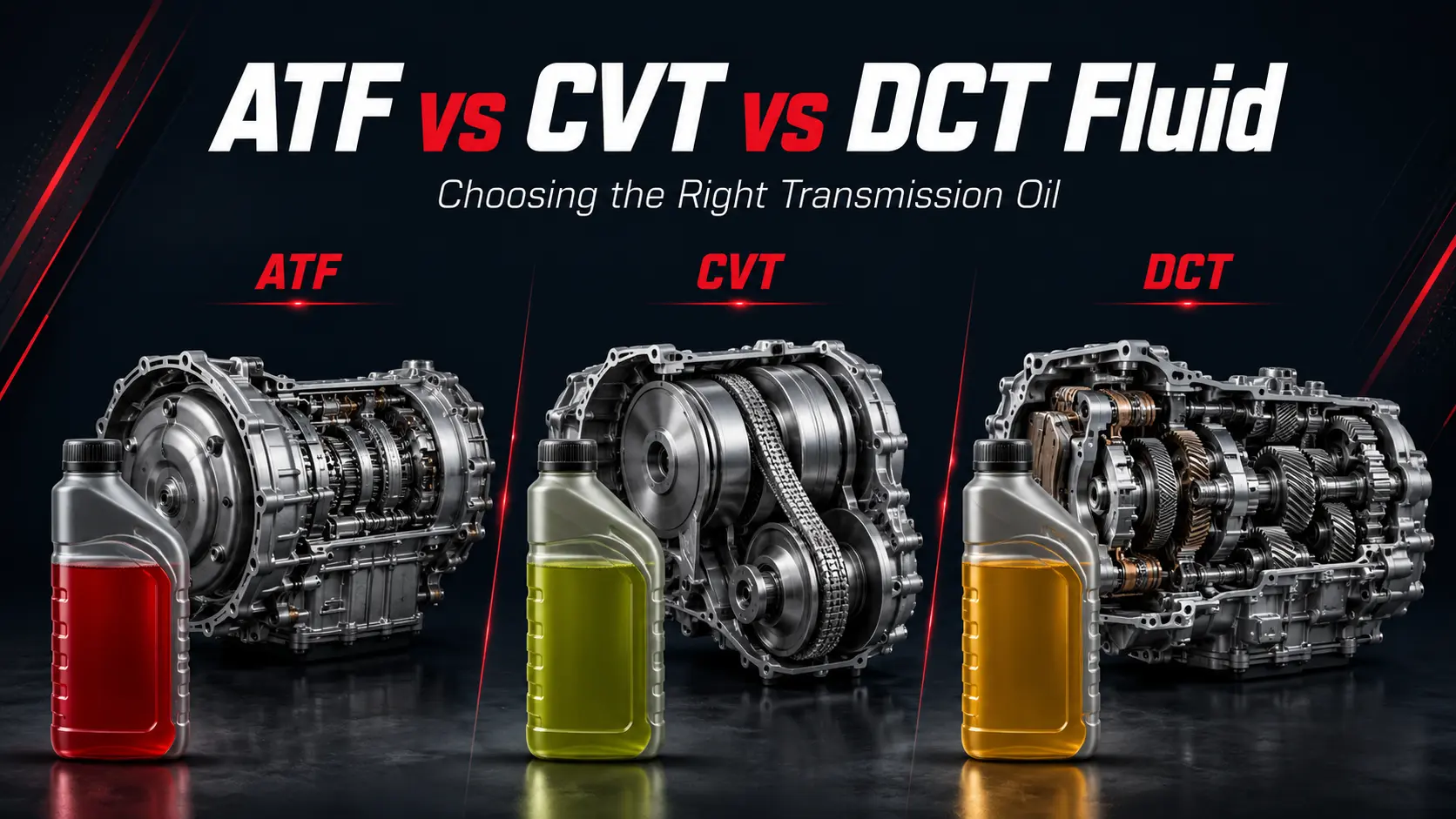
ATF is the fluid used in traditional automatic transmissions. Think torque converter plus a set of planetary gears. Lubrication isn’t its only job either. It works as a hydraulic fluid too, pushing pressure through the system so the clutches inside engage at the right moment and the converter locks up smoothly once you’re up to speed.
Because of that hydraulic job, ATF is formulated for low, predictable friction. It’s usually dyed red so it’s easy to tell apart from engine oil or coolant during a service check. Mazda is a decent example of a brand that stuck with conventional torque-converter automatics across most of its range instead of chasing CVT tech. So ATF is what you’d actually be topping up on a typical Mazda. If you’re sourcing fluid or parts for one, Mazda spare parts are worth checking before ordering anything generic off the shelf.
What Is CVT Fluid?
A CVT skips fixed gears entirely. Power runs through a belt or chain stretched between two pulleys that change diameter, and the transmission shifts ratio by adjusting how wide each pulley opens. That setup needs something ATF was never built to give it. High, precise friction. Without enough grip between the belt and the pulley surfaces, the belt slips, and a slipping CVT wears out fast.
CVT fluid ends up chemically different from ATF because of all that. Not relabeled. Not repackaged. It tends to run green or yellow, and most manufacturers insist on their own proprietary formula. Few brands lean on CVTs harder than Nissan, which has used them across a huge share of its lineup, from the Sentra to the X-Trail. Each generation usually calls for its own fluid spec instead of anything universal. Working on one? Nissan spare parts are a safer place to start than guessing. Mitsubishi runs CVTs in several models too, so Mitsubishi spare parts deserve the same check before you order fluid.
What Is DCT Fluid?
A dual-clutch transmission is basically two manual gearboxes crammed into one housing, one handling odd gears and the other even, so the car can pre-select the next gear and swap almost instantly. Wet-clutch DCTs run a fluid that borrows a bit from both ATF and manual gear oil, tuned for exact clutch engagement and enough thermal stability to survive repeated hard shifts. Dry-clutch DCTs work differently again and typically just run conventional manual transmission oil instead.
Chinese-brand SUVs sold across Dubai fall into this category a lot. Take the Changan CS75. Most trims come fitted with a 7-speed wet dual-clutch transmission, so the fluid needs to match that setup exactly, not a generic ATF substitute. Changan CS75 transmission oil is the right place to check the correct reference. The CS35 is messier. Depending on the model year and market, it’s turned up with either a CVT or a 7-speed DCT, so confirm which one you’ve actually got before ordering Changan CS35 transmission oil. Curious how Chinese-brand vehicles differ under the skin more broadly? Chinese Car Spare Parts covers that ground.
ATF vs CVT vs DCT Fluid: Quick Comparison
| Fluid Type | Used In | Friction Behaviour | Typical Colour | Approx. Replacement Interval |
| ATF | Traditional automatic with torque converter | Low, smooth friction for clutch and converter lockup | Usually red | Roughly 96,000 to 160,000 km under normal use |
| CVT Fluid | Belt or chain driven CVT | High, precise friction to stop belt slippage | Often green or yellow | Roughly 48,000 to 96,000 km under normal use |
| DCT Fluid | Dual-clutch transmission, wet or dry | Tuned for fast, exact clutch engagement | Varies by manufacturer | Roughly 64,000 to 96,000 km under normal use |
These are general industry ranges, not manufacturer-specific figures. Severe conditions, think heavy traffic, extreme heat, or frequent short trips, can cut all three intervals roughly in half. Always confirm the exact interval in your owner’s manual.
Why You Can’t Use One in Place of Another
None of these three fluids substitute for another. Not even temporarily. ATF poured into a CVT strips the belt of the grip it needs. That leads to slipping, glazing on the pulley surfaces, and premature failure. Get the fluid wrong in a DCT and clutch engagement turns rough or hesitant. Mechanics sometimes call it shudder. Heat builds up faster than the fluid can handle too. Manufacturers spend years tuning the friction chemistry for each design. There’s no shortcut around that, no matter what a bottle on a shelf claims.
How Often Should You Change Transmission Fluid?
The table above gives a starting point. Your actual interval depends on the vehicle, the driving conditions, and what the manufacturer specifies for that exact model. Heavy stop-start traffic, towing, or regularly driving in high heat push these numbers down, not up. If you’re not sure what’s in your transmission or when it was last serviced, check that before symptoms show up, not after. A full breakdown of how model, engine, and transmission all affect part compatibility sits in Car Spare Parts by Brand in Dubai: A Complete Guide.
Getting ATF vs CVT vs DCT fluid right really comes down to one habit: confirm what transmission your car actually has before you buy anything. Match the fluid to the spec, not just the model name, and the transmission keeps shifting the way it’s supposed to for a long time.