Monday to Saturday - 8:00 -17:30

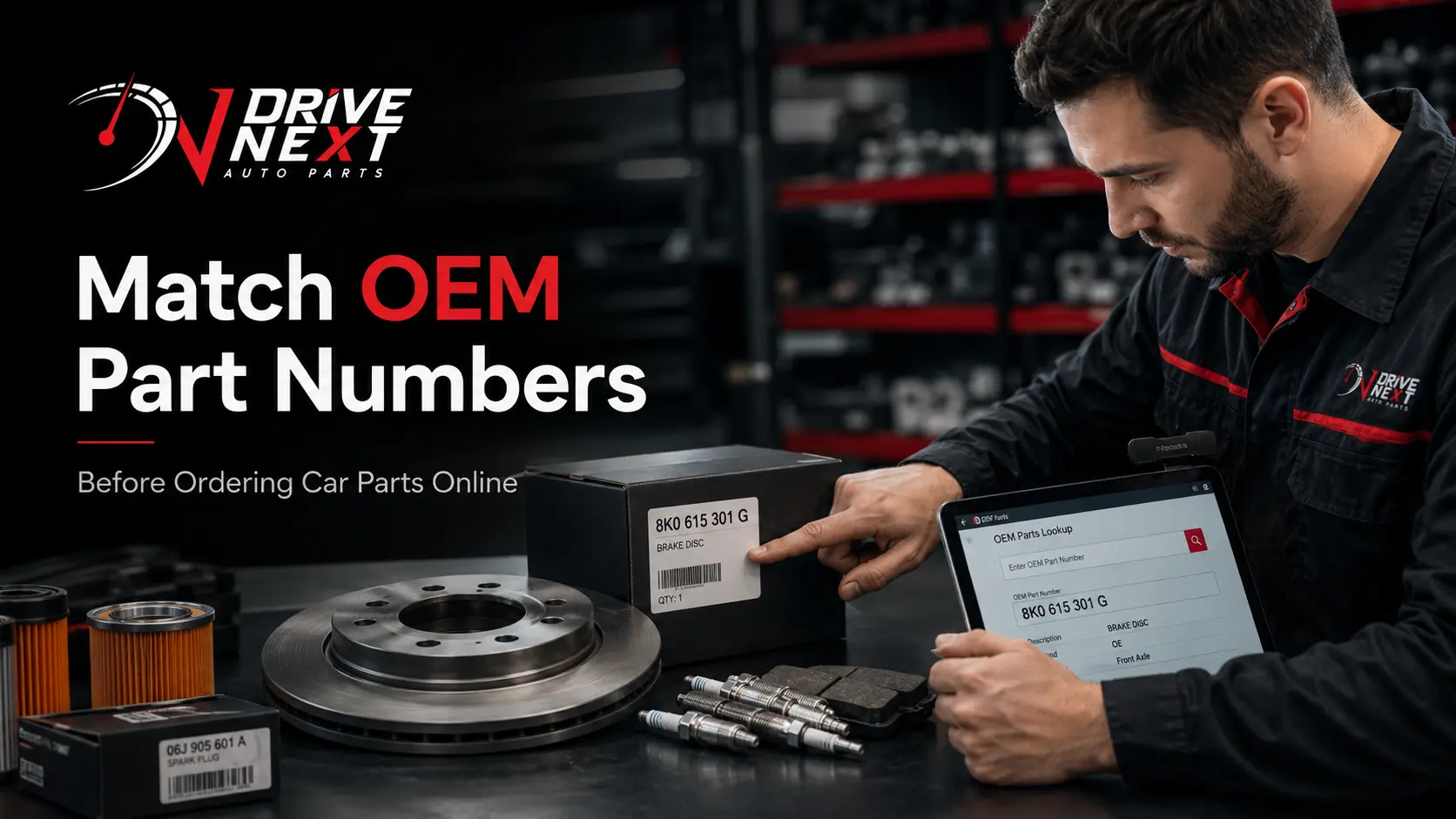
Buying car parts online is easy. Getting the right one isn’t, not always. Two components can look completely identical in the product photos and still have different connectors, different dimensions, or mounting points that just won’t line up.
The most reliable way around this is the OEM part number. It points to the exact component built for a specific vehicle configuration. The trouble is, these numbers can be a mess to read, packed with letters, digits, prefixes, suffixes, and the occasional replacement reference thrown in.
Once you understand how these numbers actually work, narrowing down the right part gets a lot easier, and you stop wasting money on things that were never going to fit.
What Is an OEM Part Number?
An OEM part number is a unique reference tied to a specific vehicle component by the manufacturer or its official parts system.
OEM stands for Original Equipment Manufacturer. In the parts trade, people use the term for anything linked back to the original component specification.
You’ll usually find the number on:
- The component itself
- Manufacturer packaging
- A printed label or sticker
- A metal plate
- A plastic housing
- A service invoice
- An authorised parts catalogue
Some manufacturers use only digits. Others mix letters, numbers, spaces, and hyphens together, and there’s no single standard across brands.
Take a filter, a sensor, or a brake component. It might have three or four different markings stamped or printed on it, and only one of those is the actual part number. The rest could be a production batch code, a material grade, a factory ID, or a manufacturing date.
Why the OEM Number Matters
Manufacturers love selling the same model with a dozen different engine, transmission, and trim combinations, sometimes tweaked further for whichever regional market it’s headed to. All of that changes what parts actually go into the car.
So a product listed as fitting “your model” might still come in several different versions underneath.
This is where the OEM number earns its keep. It cuts through that uncertainty by pointing to one exact reference. It matters a lot when you’re buying:
- Engine sensors
- Filters
- Water pumps
- Engine mounts
- Brake pads
- Suspension components
- Electrical parts
- AC compressors
- Transmission parts
- Body components
That said, don’t treat the number as gospel on its own. Cross-check it against the vehicle model, production year, engine code, and VIN too. It’s a strong indicator, not the whole answer.
For a wider look at how model years, engines, and part positions all factor into compatibility, there’s a full breakdown here: Car Spare Parts by Brand in Dubai: A Complete Guide.
Where to Find the Part Number on a Car Component
Depends on the part, honestly.
Filters usually print the reference right on the outer casing. Sensors might carry a small engraved or laser-etched code. Brake pads often have the number stamped into the backing plate. Engine and suspension parts tend to use stickers, cast markings, or numbers engraved straight into the metal.
Before you pull the old part off, snap a few clear photos from different angles. Once it’s out, clean off any dirt or oil that’s covering the markings, but skip harsh chemicals that could wipe the printing off entirely.
While you’re checking the number:
- Record the whole thing, not just part of it.
- Include every letter and digit.
- Keep spaces and hyphens exactly as printed.
- Check if the number shows up more than once on the part.
- Get a clear photo of it.
- Compare it against the product listing and supplier records.
Get one character wrong and you’re looking at data for a different part entirely.
How to Separate the Part Number from Other Codes
A single component can carry several codes at once, and this is where a lot of online buyers slip up.
You might see any combination of:
- Manufacturer part number
- Supplier reference
- Production date
- Serial number
- Batch number
- Material code
- Certification mark
- Barcode number
Don’t assume the longest string of digits is the OEM reference. It often isn’t.
Look instead for labels like:
- Part No.
- P/N
- OE
- OEM
- Reference
- Model
- Assy No.
If the markings are genuinely unclear, just send photos to a parts supplier along with the vehicle details. Someone who works with these catalogues daily can match the visible codes against a real database instead of guessing off one number.
Understand Prefixes, Main Numbers, and Suffixes
Some manufacturers break a part number down into sections. A typical one might have:
- A prefix marking the component category
- A central number identifying the main part
- A suffix flagging a revision, colour, side, material, or vehicle variation
None of this is universal, though. Toyota reads its numbers differently than Nissan does, and Honda, Kia, and Mitsubishi each run their own systems too.
That’s exactly why you shouldn’t drop letters or suffixes just because two references look nearly the same. A single different digit at the end can mean a revised design, a different connector, the opposite side of the car, or an entirely different vehicle application.
If you’re after nissan spare parts in dubai, share the complete reference whenever you can. One Nissan model might run different components across generations, engines, and regional builds, and a partial number won’t catch that.
What Is a Superseded Part Number?
Manufacturers sometimes retire an old part number and replace it with a new one. That’s called supersession.
It happens for a few reasons:
- The component design got updated
- The original supplier changed
- Packaging was revised
- Several older references got merged into one
- A technical improvement came in
- The manufacturer overhauled its numbering system
A superseded number doesn’t mean the old part was ever wrong. It usually just means there’s now an updated version sold under a new reference.
If an online listing shows a different number than what’s on your old part, ask whether it officially replaces the original. A good supplier can confirm that through a manufacturer catalogue or a proper parts database rather than just telling you it “should be fine.”
This matters most on electrical, engine, braking, and transmission parts, where a wrong guess costs real money.
Match the Part Number with Vehicle Details
Finding the same number listed online is a good sign, but it shouldn’t be the end of your check.
Before you order, compare:
- Vehicle make and model
- Manufacturing year
- Engine size
- Engine code
- Transmission type
- VIN or chassis number
- Front or rear position
- Left or right side
- Product dimensions
- Connector shape
- Mounting points
- Old and new part numbers
For honda spare parts, the engine code and production year end up mattering a lot, especially with filters, ignition parts, mounts, sensors, and cooling-system components.
The same goes for anyone picking out kia maintenance parts. Confirm the listing actually applies to your exact engine and model generation rather than trusting the model name alone.
It’s no different with mitsubishi maintenance parts, particularly on models sold with multiple engines, drivetrains, or body styles.
Be Careful with Partial Number Matches
Online marketplaces will happily show you products that only match part of what you typed into the search bar.
Search a ten-character part number and you might get results that only match the first six. Those parts could belong to the right category and still be wrong for your specific vehicle.
Always open the full product description and check the complete reference. Don’t trust the title, the search snippet, or the photo alone, they’re not enough by themselves.
A decent listing should spell out:
- Compatible models
- Applicable years
- Part position
- Product quantity
- Brand or manufacturer
- Reference numbers
- Installation requirements
Missing any of that? Ask before you buy, not after.
Does a Matching OEM Number Guarantee Fitment?
A full, correctly matched OEM number gets you most of the way there, but physical verification still has its place.
Cars get modified. Someone might have repaired a vehicle with parts from another variant, or upgraded a component along the way. The original number could also just be worn away or recorded wrong somewhere down the line.
For pricier or more technical parts, ask the supplier to verify the OEM number against the VIN directly. It’s also worth comparing old and new components side by side before installing anything.
Check:
- Overall shape
- Connector count
- Bolt pattern
- Hose connections
- Length and width
- Left or right orientation
- Electrical pins
- Mounting brackets
Don’t install the part until you’re confident it’s right. A lot of suppliers won’t accept a return once something shows signs of being fitted or used.
Common Mistakes to Avoid
- Entering only part of the reference
- Confusing zero with the letter O
- Confusing one with the letter I
- Ignoring a suffix
- Using a serial number instead of the part number
- Assuming every model year uses the same component
- Ordering off a photo alone
- Ignoring front, rear, left, or right position
- Treating a similar number as an exact match
- Installing the part before checking compatibility
A few extra minutes spent verifying the reference beats a return dispute, a delayed order, or damage from a part that was never going to fit properly.
Final Check Before Ordering
Before you place the order, send the supplier the full OEM part number, vehicle model, manufacturing year, engine details, and VIN. Throw in photos of the old component too if the number’s hard to read or there are several versions floating around online.
The OEM number is one of the most useful tools you’ve got for identifying a car part, but it works best alongside complete vehicle information, not instead of it. Match the reference carefully and you move past “looks about right” into knowing the product actually fits your vehicle.