Monday to Saturday - 8:00 -17:30

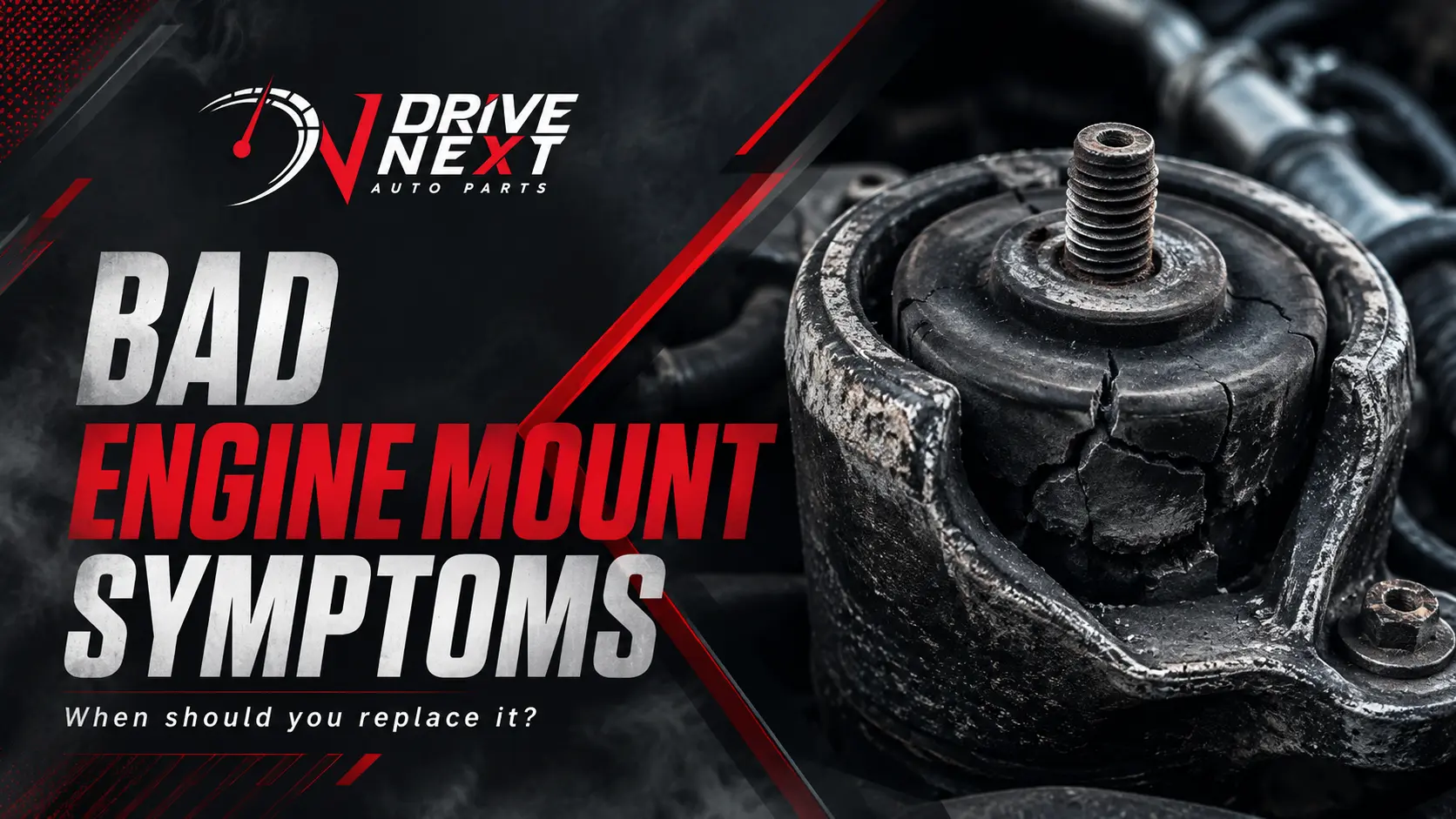
A worn engine mount rarely announces itself all at once. It starts small, a faint clunk when you shift into reverse, a bit more shake at idle than you remember, and most drivers just write it off as normal wear until the noise gets loud enough to actually worry about.
That’s usually a mistake. Catch bad engine mount symptoms early and you save yourself from a much bigger repair down the line. A failing mount doesn’t just make noise. It lets the engine move around in ways it was never built to.
What an Engine Mount Actually Does
Every engine sits on two to four mounts, and their job is simple to describe but easy to underestimate. They hold the engine and transmission against the chassis while soaking up the constant vibration and torque that combustion and gear changes throw off. Take them away and all of that force would land straight in the cabin, through the steering wheel, the seat, the pedals, everywhere at once.
Most cars run rubber mounts. The rubber flexes under load and cushions engine movement well, right up until age and heat exposure harden it and it starts to crack. Some higher-end models use hydraulic mounts instead, which lean on internal fluid to dampen vibration more precisely. They do the job a bit better, but cost more, and if the internal seal ever fails the fluid leaks out and the mount is done.
Bad Engine Mount Symptoms to Watch For
A failing mount tends to show up in a handful of specific ways:
- Clunking or banging from the engine bay, especially shifting between Drive and Reverse, or during hard acceleration.
- Noticeably more vibration than usual at idle, felt through the steering wheel, seat, or floor.
- The engine visibly rocking, tilting, or sitting unevenly when you look under the hood.
- A jolt or thump when changing gears, sometimes described as the whole car lurching.
- Rougher idle than normal, or a shudder that wasn’t there before.
- Rattling that gets worse as engine speed increases.
None of these symptoms confirm a bad mount on their own. Worn suspension can feel similar. So can an exhaust issue, or a wheel alignment problem gone unnoticed. But stack a few of these together, especially that clunk on gear changes, and the mount is almost always the real cause.
What Causes an Engine Mount to Fail
Three things drive most mount failures, and they rarely act alone.
- Heat and age. Rubber sitting close to a hot engine for years gradually hardens, and hardened rubber cracks instead of flexing.
- Fluid contamination. Oil or transmission fluid leaking onto a mount speeds that process up considerably. Fluid-soaked rubber softens and loses its structural integrity far faster than heat alone ever would.
- Impact damage. A hard pothole hit, a low-speed collision, or aggressive off-road driving can crack the rubber or bend the metal bracket outright, and that kind of damage shows up immediately rather than gradually.
Ignore a bad mount long enough and it stops being just a noise problem. The extra engine movement puts stress on belts, hoses, and the exhaust system, and in some cases it starts affecting how smoothly the transmission shifts too.
Matching the Mount to Your Actual Vehicle
Most vehicles run several mounts at once, front, rear, left, and right, and each one usually carries its own part number even on the same car. Go by the model name alone and odds are you’ll end up ordering the wrong one.
Changan is a good example of just how much this varies within one brand:
- The CS85 uses its own mount specification, so a Changan CS85 engine mount needs to match that model specifically rather than a generic Changan listing.
- The UNI-V is built differently again. Its rear mount, the Changan Uni-V rear engine mount, sits in a different position with different load requirements than the front mount on the same car.
- The CS95 adds another wrinkle, since left and right side mounts aren’t interchangeable. A Changan Mounting LH CS95 refers specifically to the left-hand side.
For anything else across the range, Changan Parts is worth checking against your exact trim before you order.
The same holds true for other brands sold across Dubai. Nissan and Kia both run multiple mount positions per engine, and specs shift between generations even within the same model line. Check Nissan spare parts or KIA spare parts against your VIN instead of assuming last year’s part number still fits.
When Should You Actually Replace It?
If you’re hearing a clunk on gear changes or feeling more vibration than usual, get it checked before it turns into a bigger repair. A mechanic can usually confirm a failing mount fairly quickly, by putting the transmission in gear while the car sits still and watching how much the engine shifts.
Waiting it out rarely saves money. The longer a bad mount stays in place, the more stress it puts on everything bolted near it, and that bill only grows.
None of this is complicated once you know what to check. Match the mount to your exact model and position, and stay ahead of bad engine mount symptoms before they turn into something bigger. For a wider look at how model, trim, and position affect part compatibility across brands, Car Spare Parts by Brand in Dubai: A Complete Guide has that covered.