Monday to Saturday - 8:00 -17:30

You give the counter staff your car’s model and year. Wait a few days. The part shows up, and it’s got the wrong bolt pattern, or the connector doesn’t match, or it just won’t seat right. Sound familiar? Nine times out of ten, that whole mess traces back to one missed step: nobody asked for the VIN.
Two cars can leave the same factory wearing the same model badge and still be nothing alike underneath. Different engines. Different transmissions. Different trim packages depending on which market they were built for. A model name tells you what people call the car. It doesn’t tell a parts supplier what’s actually bolted onto it.
That’s the whole point of the Vehicle Identification Number, or VIN, sometimes called the chassis number. It’s a fingerprint for your specific vehicle rather than a rough guess pieced together from a name and a year.
So if you’re after filters, engine mounts, sensors, brake parts, or anything in the cooling system, handing over the VIN before you order saves time on both ends. It also cuts down on the chances of a part arriving that simply doesn’t fit.
What Is a VIN or Chassis Number?
A VIN is a 17-character code assigned by the manufacturer. It’s a mix of letters and numbers that encodes the maker, the model range, some production details, and a serial identity unique to that one car.
People use VIN and chassis number more or less interchangeably in conversation, and for most modern vehicles they do refer to the same thing. Older cars can be different. Depending on the year and where the vehicle was built, you might run into a shorter chassis number instead of the full 17 digits.
Worth repeating, because it trips up a lot of people: the VIN is not your number plate. The plate comes from the local transport authority and can change if the car gets re-registered somewhere else. The VIN doesn’t. It stays attached to that vehicle for life.
Why the VIN Matters When Buying Spare Parts
A model name alone rarely tells the whole story. Take any single model line and it could have shipped with:
- Different engine sizes
- Petrol, diesel, hybrid, or turbocharged variants
- Manual, automatic, CVT, or dual-clutch gearboxes
- Front-wheel drive or all-wheel drive
- Different brake setups
- Multiple trims and regional specs
- Pre-facelift and facelift body styles
A part that fits one version won’t necessarily fit another, even if the badge and year match perfectly on paper.
Run the VIN through a proper lookup and a supplier can check the vehicle’s actual recorded spec instead of guessing off the name. This matters a lot when you’re browsing Auto Spare Parts in Dubai, since so many cars here were imported from different regional markets, each carrying its own factory configuration.
Where Can You Find the VIN?
It’s stamped or printed in a few predictable spots, both on the car and in the paperwork that comes with it.
Vehicle registration card
In the UAE it’s usually right there on the registration card, the Mulkiya.
Dashboard
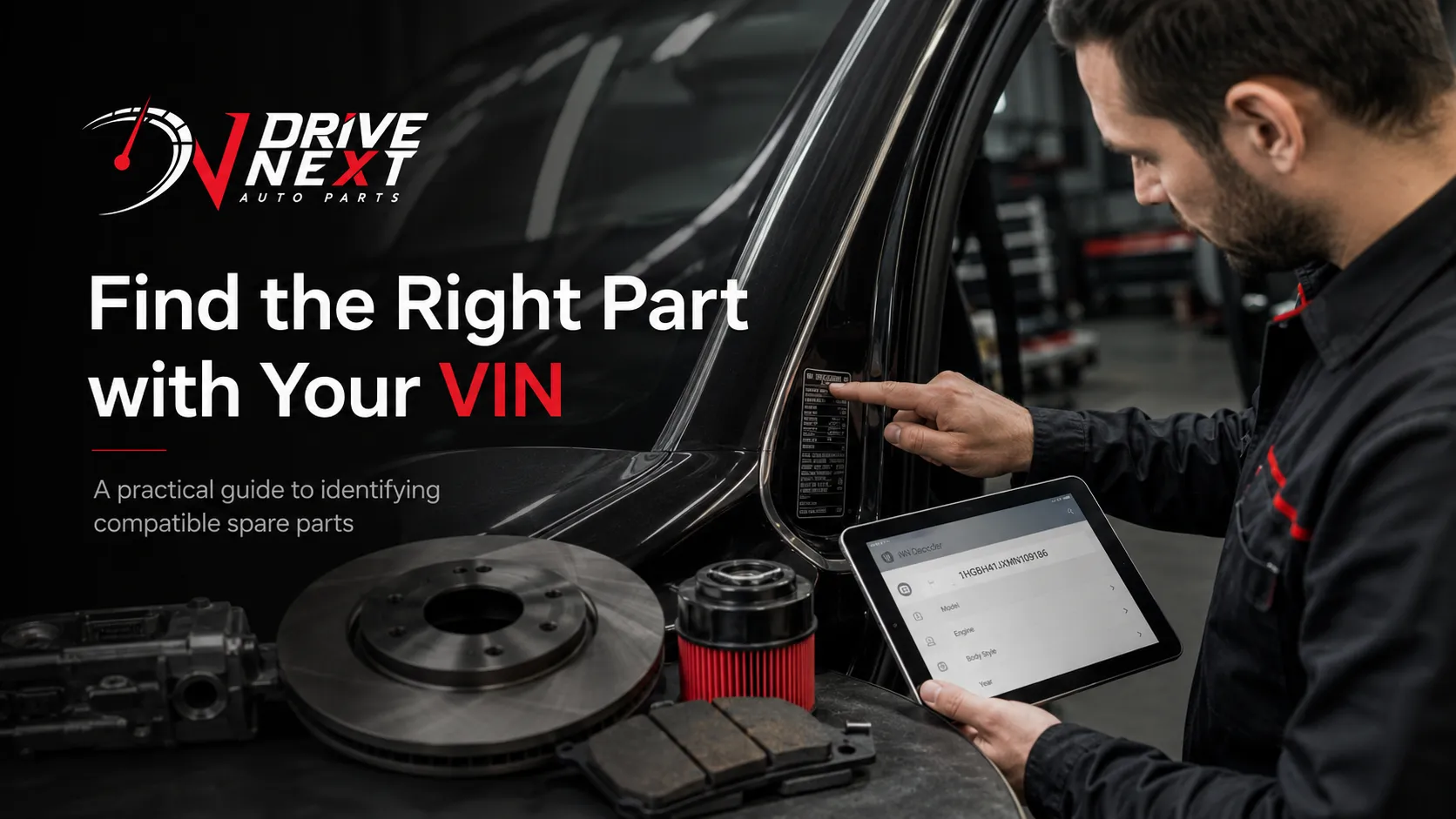
Look through the windscreen from the outside, driver’s side. There’s often a small metal plate where the dash meets the glass.
Driver-side door frame
Open the door and check the pillar. Most manufacturers stick a label here with the VIN plus the production date, tyre specs, and a bit of other vehicle data.
Engine bay
Sometimes it’s stamped straight onto the body, the firewall, or the chassis itself, somewhere in the engine compartment.
Insurance or service records
It also turns up on insurance papers, dealership invoices, inspection reports, and old service records. Useful if you can’t get out to the car right away.
Copy it carefully. Get one character wrong and you’ll pull up data for a completely different vehicle.
How to Use the VIN to Find a Spare Part
1. Figure Out What Part You Actually Need
Start by pinning down which component has actually failed. If that’s not obvious, get it looked at first rather than guessing.
An engine running hot doesn’t automatically mean a dead water pump, for example. Could be the thermostat. It could be the radiator, a failing fan, or a coolant leak somewhere else entirely. Swap the wrong part and you’ve just spent money without fixing anything.
2. Pull Together the Vehicle Details
Along with the VIN, have this ready:
- Make and model
- Manufacturing year
- Engine size
- Transmission type
- Name of the part
- Position (front, rear, left, right, wherever relevant)
- The old part number, if you can find it
All of this backs up the VIN check and helps a supplier narrow things down faster.
3. Send the VIN to A Supplier You Trust
A clear photo works, or type it out carefully. Skip posting the full number on public forums or in social media comments. Send it privately through a proper enquiry channel instead.
From there, a supplier can cross-reference it against manufacturer catalogues and parts databases to land on the correct reference.
4. Match it Against the Original Part Number
The VIN tells you about the vehicle. The part number tells you about the component. Together, they give you a much stronger compatibility check than either one on its own.
Check the old part for a label, stamp, or engraving, and make sure you get the full number down. Similar parts can carry numbers that differ by a single digit or letter.
5. Confirm the Fit Before Anything Gets Installed
Check the packaging, the connector type, mounting points, dimensions, and the product description against what came off the car. And for anything touching the engine, brakes, suspension, electrical system, or transmission, pay for professional installation. It’s worth it.
Once something’s fitted, returning it gets difficult fast, sometimes impossible. This step is really your last chance to catch a mistake before it costs you.
Can a VIN Identify Every Spare Part?
Not always, if we’re being honest. It gets you most of the way, but it isn’t bulletproof.
Plenty of cars pick up modifications after they leave the factory floor. Maybe a previous owner swapped the engine, upgraded the brakes, changed the suspension, or bolted on a part from a completely different variant. Once that happens, the VIN record on file stops matching everything actually sitting under the hood.
In those cases, expect a supplier to ask for more, things like:
- A photo of the old part
- The original part number
- Connector details
- Physical measurements
- Engine code
- Transmission code
- Production date
- Which side, left or right
Treat the VIN as your starting point, not the final answer. Pair it with the physical part details rather than leaning on one or the other alone.
Using a VIN for Brand-Specific Engine Parts
This matters most on engine-related orders, since a single model can be sold across several engine options over its production life.
Looking for Changan Engine Parts in Dubai? Hand over the full model name, the VIN, engine size, and manufacturing year together. Models like the CS35, CS75, CS85, Alsvin, Eado, and the UNI series have all run different engine configurations depending on the year they were built.
Same story for Toyota Engine Parts in Dubai. A Corolla, Prado, Camry, or Land Cruiser can span multiple engine variants over its life, and each one needs its own filters, belts, pumps, sensors, and gaskets.
Shopping for Honda engine parts, confirm the engine code alongside the VIN too. It matters most for ignition, cooling, timing, filtration, and mounting components, where the spec differences are small but they add up fast.
Want a deeper breakdown of how make, model, year, engine, and part number all interact to determine fitment? There’s a full guide on that here: Car Spare Parts by Brand in Dubai: A Complete Guide.
Common VIN-Related Mistakes to Avoid
Don’t assume the tenth character of the VIN hands you everything you need for an order. VIN decoding isn’t standardized across every market and manufacturer, so that shortcut falls apart more often than you’d think.
A few other things people get wrong:
- Sending an incomplete VIN
- Mixing up the letter O with the number 0
- Mixing up the letter I with the number 1
- Sharing the plate number instead of the actual chassis number
- Working off an outdated registration card
- Assuming matching model names mean matching parts
- Placing the order before compatibility is actually confirmed
A few extra minutes checking this stuff upfront beats a delayed order, a return argument, or paying twice for installation.
Final Thoughts
The VIN or chassis number is still one of the most reliable places to start when you’re tracking down a part that will actually fit. It hands a supplier information that the brand or model name alone just can’t match.
For the best shot at getting it right, share the VIN along with the model year, engine details, transmission type, part position, and the old part number if you’ve got it. A photo of the existing component helps too, especially on models that come in several trim or engine variants.
Get this information sorted at the start and finding the right product gets a lot easier. It also saves you the headache of a part that looks fine on paper but just doesn’t fit your car.