Monday to Saturday - 8:00 -17:30

Most people start their search for a car part with the vehicle brand, and that’s a fair starting point. But the brand name alone rarely tells a supplier enough to confirm whether a part will actually fit. It’s one of the most common mix-ups our team sees, someone orders “a Toyota filter” or “Honda brake pads” without realizing their exact model might need something quite different from the version pictured online.
The same manufacturer often builds several models, engine options, trims, and generations at once. Two parts can look nearly identical on a shelf while differing in measurements, connectors, mounting points, or specs. A brake pad that fits one Kia might sit a few millimeters off on another, close enough to install, wrong enough to cause problems later.
DrivNext Auto Parts lists Auto Spare Parts in Dubai for Changan, Toyota, Honda, Nissan, Mitsubishi, Mazda, Kia, MG, Geely, and Jetour. The catalog is organized by brand so customers can narrow things down before checking the exact model and product requirements.
This guide covers what to check when choosing car spare parts by brand in Dubai and how to avoid ordering the wrong component in the first place.
Why the Car Brand Is Only the Starting Point
Manufacturers design parts around the requirements of individual models, not the brand as a whole. Even two vehicles carrying the same badge can use completely different filters, brake pads, engine components, or cooling parts.
A few things usually decide whether a part fits:
- Vehicle model
- Manufacturing year
- Engine size and engine code
- Transmission type
- Trim or variant
- Body style
- Front or rear position
- Left or right side
- Vehicle Identification Number (VIN)
- Original part number
Searching “Changan brake pads” pulls up several possible matches. Searching “Changan CS85 front brake pads, 2020 to 2025” narrows it down fast, and gets a far more useful answer. The same logic holds whether you’re shopping for Toyota, Nissan, Honda, Kia, Mazda, Mitsubishi, MG, Geely, or Jetour parts.
Information to Check Before Buying a Car Part
Having the right details ready before you start makes the whole search faster, and it saves a round trip if something doesn’t fit.
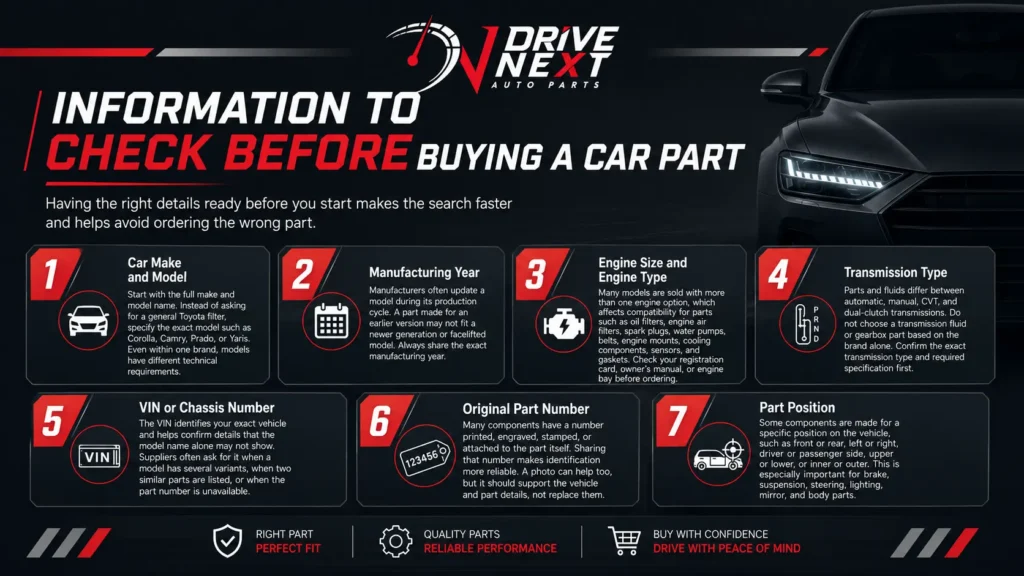
1. Car Make and Model
Start with the full make and model name. Instead of asking for a general “Toyota filter,” say whether you need one for a Corolla, Camry, Prado, or Yaris. Even within one lineup, models tend to have their own technical requirements, so being specific here saves time later.
2. Manufacturing Year
Manufacturers often update a model partway through its production run, sometimes touching the engine, sometimes the body, sometimes the electronics. A part built for an earlier version may not fit a newer generation or a facelifted model. Share the exact manufacturing year whenever you request a part; it’s one of the first things a supplier will ask anyway.
3. Engine Size and Engine Type
Most models are sold with more than one engine option, and that affects compatibility for things like:
- Oil filters
- Engine air filters
- Spark plugs
- Water pumps
- Belts
- Engine mounts
- Cooling components
- Sensors
- Gaskets
Your registration card (Mulkiya), owner’s manual, or the engine bay itself will usually have this information. Worth checking before ordering anything engine-related.
4. Transmission Type
Parts and fluids differ between automatic, manual, CVT, and dual-clutch transmissions, sometimes by more than people expect. Don’t pick a transmission fluid or gearbox part based on the brand alone. Confirm the exact transmission type and the required spec first.
5. VIN or Chassis Number
The VIN identifies your exact vehicle and can surface details recorded by the manufacturer that the model name alone won’t tell you, useful when the model year, configuration, or trim isn’t obvious from the outside.
A supplier is likely to ask for your VIN or chassis number when the model has several variants, when two similar parts are both listed, when the vehicle was built during a mid-cycle update, or when the part number simply isn’t available.
6. Original Part Number
Many components have a number printed, engraved, stamped, or attached somewhere on the part itself. Passing this along makes identification far more reliable than a description alone. Read it carefully; a single digit off can point to an entirely different version. A photo helps too, but it should go along with the vehicle and part details, not replace them.
7. Part Position
Some components are built for a specific spot on the vehicle: front or rear, left or right, driver or passenger side, upper or lower, inner or outer. This matters most for brake, suspension, steering, lighting, mirror, and body parts, where a mirrored part looks almost identical but won’t bolt on correctly.
Understanding Genuine, OEM, and Aftermarket Parts
Shoppers run into three terms fairly quickly: genuine, OEM, and aftermarket.
Genuine parts are supplied under the vehicle manufacturer’s own brand and built for specific vehicle applications. Even with a genuine part, it’s worth checking the model, year, engine, and part number. A genuine Toyota or Changan component won’t automatically fit every vehicle the brand has ever built.
OEM stands for Original Equipment Manufacturer and generally refers to a company involved in producing components supplied for vehicle manufacturing. Packaging and sales channels can vary quite a bit between suppliers, so confirm exactly what’s being offered before buying.
Aftermarket parts come from companies outside the manufacturer’s own supply chain. Quality and spec vary from one maker to another, sometimes noticeably, so check the product brand, compatibility, warranty terms, and supplier reputation before purchasing.
Choosing Parts for Different Car Brands
Each brand has its own quirks, and the exact model and vehicle details still need confirming no matter which one you drive.
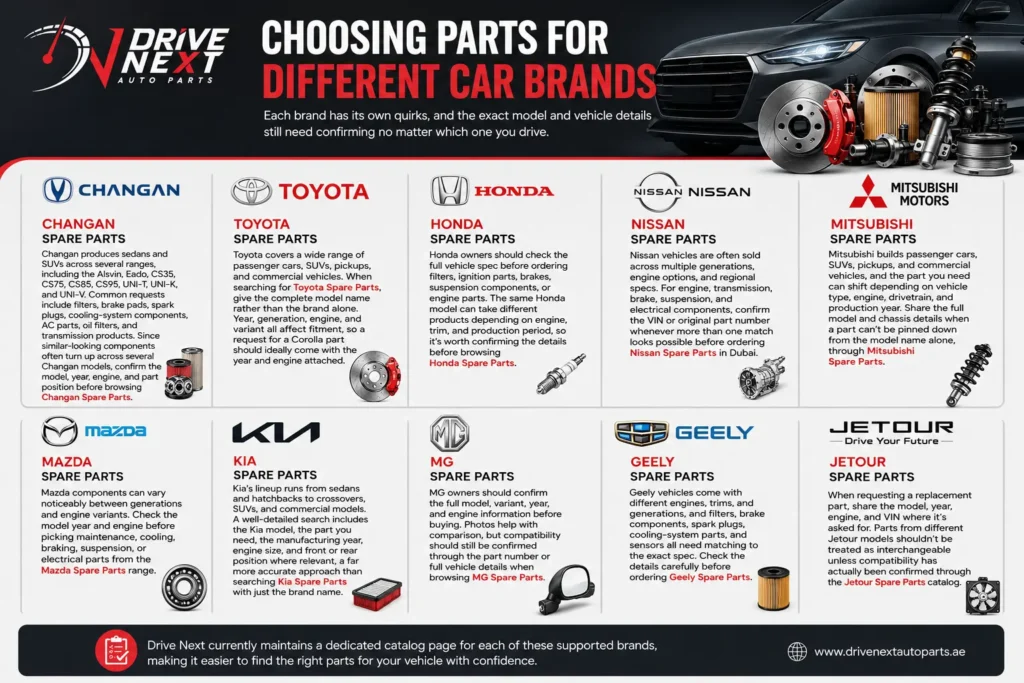
Changan Spare Parts
Changan produces sedans and SUVs across several ranges, including the Alsvin, Eado, CS35, CS75, CS85, CS95, UNI-T, UNI-K, and UNI-V. Common requests include filters, brake pads, spark plugs, cooling-system components, AC parts, oil filters, and transmission products. Since similar-looking components often turn up across several Changan models, confirm the model, year, engine, and part position before browsing Changan Spare Parts.
Toyota Spare Parts
Toyota covers a wide range of passenger cars, SUVs, pickups, and commercial vehicles. When searching for Toyota Spare Parts, give the complete model name rather than the brand alone. Year, generation, engine, and variant all affect fitment, so a request for a Corolla part should ideally come with the year and engine attached.
Honda Spare Parts
Honda owners should check the full vehicle spec before ordering filters, ignition parts, brakes, suspension components, or engine parts. The same Honda model can take different products depending on engine, trim, and production period, so it’s worth confirming the details before browsing Honda Spare Parts.
Nissan Spare Parts
Nissan vehicles are often sold across multiple generations, engine options, and regional specs. For engine, transmission, brake, suspension, and electrical components, confirm the VIN or original part number whenever more than one match looks possible before ordering Nissan Spare Parts in Dubai.
Mitsubishi Spare Parts
Mitsubishi builds passenger cars, SUVs, pickups, and commercial vehicles, and the part you need can shift depending on vehicle type, engine, drivetrain, and production year. Share the full model and chassis details when a part can’t be pinned down from the model name alone, through Mitsubishi Spare Parts.
Mazda Spare Parts
Mazda components can vary noticeably between generations and engine variants. Check the model year and engine before picking maintenance, cooling, braking, suspension, or electrical parts from the Mazda Spare Parts range.
Kia Spare Parts
Kia’s lineup runs from sedans and hatchbacks to crossovers, SUVs, and commercial models. A well-detailed search includes the Kia model, the part you need, the manufacturing year, engine size, and front or rear position where relevant, a far more accurate approach than searching Kia Spare Parts with just the brand name.
MG Spare Parts
MG owners should confirm the full model, variant, year, and engine information before buying. Photos help with comparison, but compatibility should still be confirmed through the part number or full vehicle details when browsing MG Spare Parts.
Geely Spare Parts
Geely vehicles come with different engines, trims, and generations, and filters, brake components, spark plugs, cooling-system parts, and sensors all need matching to the exact spec. Check the details carefully before ordering Geely Spare Parts.
Jetour Spare Parts
When requesting a replacement part, share the model, year, engine, and VIN where it’s asked for. Parts from different Jetour models shouldn’t be treated as interchangeable unless compatibility has actually been confirmed through the Jetour Spare Parts catalog.
DriveNext currently maintains a dedicated catalog page for each of these supported brands.
Common Types of Car Spare Parts
What you’ll need to provide changes a bit depending on the category.
Maintenance parts, oil filters, engine air filters, cabin and AC filters, spark plugs, brake pads, fluids, and belts, get replaced on their own schedules depending on vehicle, mileage, condition, and manufacturer guidance.
Engine parts should always match the engine code and technical spec. The model name alone often isn’t enough when a vehicle came with more than one engine option.
Brake parts need confirming as front or rear before ordering. For brake pads specifically, check the vehicle model, model year, position, brake-system variant, and part number.
AC and cooling parts, cabin filters, AC filters, compressors, cooling fans, water pumps, coolant reserve tanks, radiator components, see heavy use given Dubai’s summer heat. Since similar symptoms can point to different underlying faults, it’s worth diagnosing the actual issue before ordering a replacement.
Suspension and steering parts differ by axle, side, drivetrain, trim, and setup, so confirm front or rear and left or right before ordering.
Body and electrical parts often depend on trim, connector type, sensor configuration, color, or body style. A photo alone usually isn’t enough to confirm a match here.
DriveNext’s main categories cover engine, suspension, body, electrical, and maintenance components.
How to Avoid Ordering the Wrong Spare Part
A quick checklist before you complete a purchase:
- Confirm the full vehicle make and model.
- Check the manufacturing year.
- Provide the engine size or engine code.
- Confirm the transmission type.
- Share the VIN or chassis number when asked.
- Check the original part number.
- Confirm the part position.
- Compare connectors, mounting points, and dimensions where relevant.
- Read the full product description.
- Ask the supplier to confirm compatibility before installation.
Don’t install anything until you’ve actually verified it matches your vehicle’s exact application.
Questions to Ask Before Purchasing
- Does this part fit my exact model and year?
- Do you need my VIN or chassis number?
- Is this product genuine, OEM, or aftermarket?
- Is it sold individually or as a set?
- Is it built for the front or rear?
- Is it for the left or right side?
- Does a manufacturer warranty apply?
- Is the item currently in stock?
- What return conditions apply?
- Is professional installation recommended?
Many parts listed by DriveNext carry a limited warranty depending on the brand and category, so it’s worth confirming the applicable terms for the specific product you’re ordering.
Check the Return Conditions Before Installation
DriveNext’s return policy allows a seven-calendar-day return window from delivery. Eligible items need to stay unused, uninstalled, and in their original packaging, with proof of purchase included.
Electrical or electronic parts, lubricants, special-order items, and anything showing signs of installation or use may fall under restrictions. Review the full policy before opening or fitting a product; it’s exactly why getting the compatibility check right matters so much before installation begins.
Find Car Spare Parts by Brand in Dubai
Getting the right part comes down to accurate information from the start.
Begin with your vehicle brand, then confirm the model, manufacturing year, engine, transmission, VIN, and original part number. These details make it far easier to narrow down the options and confirm compatibility before anything gets installed.
DriveNext Auto Parts maintains dedicated brand pages for Changan, Toyota, Honda, Nissan, Mitsubishi, Mazda, Kia, MG, Geely, and Jetour. Browse the catalog online, or contact the team directly to check availability and confirm the right fit for your vehicle.
Frequently Asked Questions
Is the car brand enough to find the correct spare part?
Usually not, You’ll also need the model, manufacturing year, engine information, and part number where it’s available.
Can one spare part fit several car models?
Some components are listed as compatible across multiple models, but that should still be confirmed through the product description, part number, and vehicle details rather than assumed.
Why does the manufacturing year matter?
Manufacturers update vehicle designs and components between model years or generations fairly often. A part built for an older version may not fit a newer version of the same model.
Can I use a photograph to identify a car part?
It helps, but a photo should be sent along with the model, year, VIN, and part number wherever possible, not on its own.
What is the difference between front and rear brake pads?
They’re built for different positions and can differ in shape, dimensions, and spec. Always check the position before purchasing.
Should I provide the VIN when ordering?
Yes, whenever it’s asked for, especially when several variants or similar-looking components exist. A VIN can surface specific vehicle information recorded by the manufacturer.
Can I return a part after installing it?
Generally no, DriveNext’s return policy requires products to stay unused and uninstalled. Review the return conditions or contact the team before fitting anything.
Does DriveNext deliver across the UAE?
Delivery currently covers Dubai and nearby areas. Customers elsewhere should contact the team to confirm what shipping options are available.